
7 Steps to Demystifying the Sacroiliac (SI) Joint in Back Pain
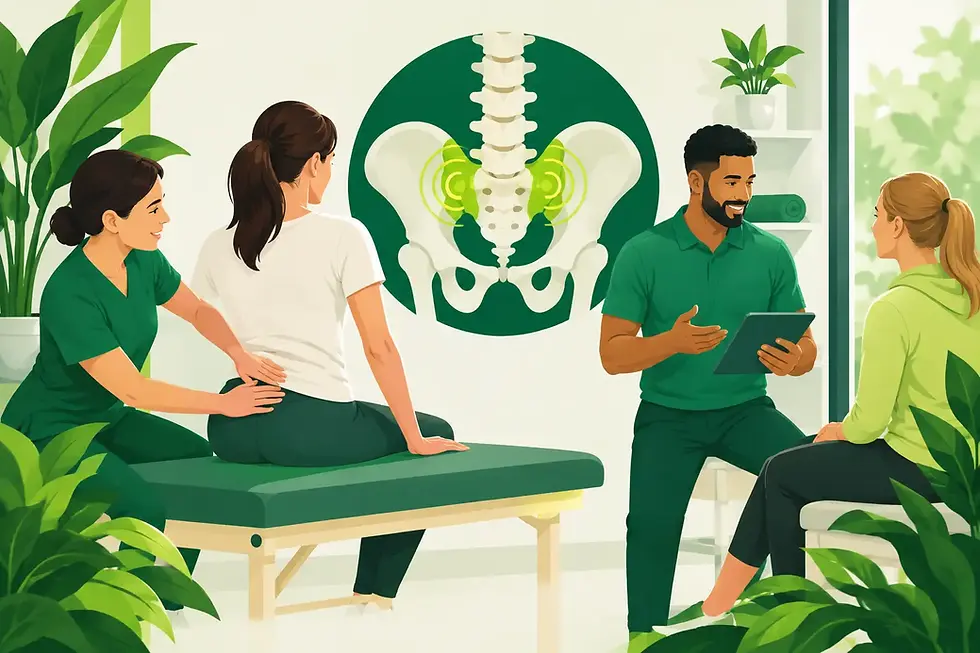
A sharp ache just to one side of the lower back can make ordinary things - getting out of the car, rolling in bed, standing at the kitchen counter - feel disproportionately difficult. Demystifying the sacroiliac (SI) joint helps put this common but often misunderstood area into perspective. It can contribute to pain, but it is rarely the whole story, and it deserves a careful assessment rather than a quick label.
The SI joint sits where the base of the spine meets the pelvis. It is small, strong and designed primarily for stability, transferring force between the upper body and legs as we walk, run, lift and turn. When the area becomes sensitive, symptoms can feel confusing because several structures in the lower back, hip and buttock can produce similar pain.
1. What the sacroiliac joint actually does
We have two SI joints, one on each side of the pelvis. They join the sacrum - the triangular bone at the bottom of the spine - to the iliac bones of the pelvis. Dense ligaments and surrounding muscles support them, allowing only a small amount of movement.
That limited movement is useful. The joints help absorb and distribute load as you take a stride, climb stairs or carry a child on one hip. They also form part of a wider system involving the lumbar spine, hips, abdominal muscles, glutes and pelvic floor. This is why an SI joint problem is not always simply a “joint out of place”.
The phrase “misaligned pelvis” is widely used, but it can be unhelpful when it implies that the body is fragile or permanently uneven. Our bodies adapt constantly. In practice, we are more interested in how your joints and tissues are tolerating load, how you move, and what may be maintaining irritation.
2. How SI joint pain may feel
SI joint-related pain is often felt around the dimples at the back of the pelvis or the upper buttock, usually more on one side. It may spread into the buttock, groin, outer hip or upper thigh. It does not usually travel below the knee in the same way that nerve-related leg pain can, although every person’s symptoms need individual assessment.
People often notice it during transitions: rising from a chair, turning in bed, getting in or out of a car, going up stairs, or taking longer strides. Sitting for a long period may aggravate it for some people, while prolonged standing is more troublesome for others.
These patterns can offer useful clues, but they do not confirm a diagnosis on their own. Low back joints, hip conditions, muscular strain and irritation of nerves can overlap significantly. A reliable plan begins with listening to the full pattern rather than relying on one painful spot.
3. Why the area can become irritated
There is rarely one single cause. Symptoms commonly develop when the demands placed on the area exceed what the body can comfortably manage at that point in time. That may follow an obvious event, such as a fall, awkward lift or increase in running mileage. Just as often, it develops gradually.
For busy professionals, long spells at a desk followed by an ambitious gym session or weekend sport can create a sharp change in load. For parents, repeated lifting, disrupted sleep and carrying children on one side can be relevant. Pregnancy and the postnatal period can also alter how the pelvis is loaded, although pelvic pain should never be dismissed as something a person simply has to endure.
Reduced hip movement, lower-back stiffness, gluteal weakness or fatigue, and poor recovery after activity may all play a part. Stress matters too. It does not mean pain is “all in your head”. Persistent stress can increase muscle tension, affect sleep and make the nervous system more alert to threat, lowering the threshold at which a previously manageable movement feels painful.
4. Why diagnosis needs more than a scan or one test
There is no single home test, scan or click in the pelvis that definitively proves the SI joint is the source of pain. Imaging can be essential in certain circumstances, but findings such as age-related changes do not always match a person’s symptoms. Equally, a normal scan does not make pain any less real.
A clinical assessment considers your history, the exact location and behaviour of symptoms, movement, hip and spinal function, muscle control, and a group of gentle provocation tests. One test alone is not especially meaningful. A consistent pattern across several findings is more informative.
We also consider what else may be involved. Pain in the groin may point more strongly towards the hip. Tingling, numbness or marked weakness may suggest nerve involvement. Pain that changes significantly with coughing or sneezing can require a different line of enquiry. This wider biomechanical view prevents us from treating a label rather than the person.
When to seek urgent medical advice
Most lower back and pelvic pain is not dangerous, but some symptoms need prompt medical assessment. Seek urgent advice if you develop new difficulty controlling your bladder or bowels, numbness around the genitals or inner thighs, rapidly worsening leg weakness, fever or feeling acutely unwell, unexplained weight loss, or pain after a significant injury.
Persistent night pain, a history of cancer, inflammatory conditions, or pain that is not settling as expected also deserves medical review. These checks are not intended to alarm you. They help make sure the right pathway is chosen early.
5. What recovery usually involves
The goal is not to “put the SI joint back” once and for all. It is to settle sensitivity, restore confidence in movement and gradually build capacity for the activities that matter to you. The right balance depends on your symptoms, work demands, sport, health history and current fitness.
In the early stage, it can help to reduce the specific movements that repeatedly flare symptoms without stopping all activity. Short, regular walks may be more comfortable than one long walk. Changing position regularly during desk work, using both legs when getting out of the car, and temporarily avoiding very uneven loading can make day-to-day life easier.
As symptoms allow, targeted exercise is often central to recovery. This may include improving hip mobility, building gluteal and trunk strength, practising controlled single-leg tasks and gradually reintroducing lifting, running or sport-specific movement. Exercise should feel appropriately challenging, not punishing. Mild, short-lived discomfort can be acceptable in some programmes; increasing pain that lingers or alters your movement is a sign to adjust the dose.
Sleep, recovery and overall activity levels matter as much as a perfect exercise selection. For someone training hard while managing a demanding job, the most useful change may be pacing load across the week. For someone who has become understandably cautious after months of pain, the priority may be rebuilding trust through small, repeatable wins.
6. Where osteopathy and sports massage can help
Hands-on care can be useful when it sits within an active plan. Osteopathic assessment looks at how the spine, pelvis, hips and surrounding soft tissues work together, while also considering the practical demands of your everyday life. Treatment may include gentle joint techniques, soft-tissue work and advice to improve comfortable movement.
Sports massage can complement this approach where muscular tension in the glutes, hip flexors, lower back or thighs is contributing to restricted movement or a feeling of guarding. It can help you move more freely, but it is not a substitute for progressive rehabilitation. Lasting change usually comes from pairing symptom relief with a realistic strengthening and movement plan.
At Hartwood Health in Fleet, osteopathy and sports massage can be coordinated when that combination suits your presentation. We will not assume that every SI-area pain needs the same treatment. Some people benefit most from hands-on care initially; others need a clearer exercise strategy, medical review, or simply reassurance that movement is safe again.
7. A calmer way to think about your pelvis
Pain around the SI joint can be stubborn, particularly when you are trying to stay productive at work, train for an event or keep up with family life. That does not mean your pelvis is damaged or that you need to avoid activity indefinitely. With a clear assessment and a plan that respects your starting point, most people can work towards more comfortable, confident movement.
If lower back or buttock pain is limiting the things you value, start by seeking an assessment that looks beyond the single painful area. A thoughtful explanation, the right pacing and progressive support can turn a worrying symptom into a manageable route back to everyday life.
Joined-Up Care for Lasting Physical Freedom
At Hartwood Health, we look beyond the immediate symptom to treat the person attached to it. True physical resilience requires a balance between structural alignment, everyday biomechanics, and systemic health.
Our Osteopathy Team specialises in relieving acute pain and restoring mobility for busy professionals and active adults alike. By working closely alongside our clinical dietitians and other wellbeing practitioners, they provide a truly "joined-up" approach to physical health.
Visit our hands-on clinic in Fleet to start your journey back to comfortable, confident movement.


